
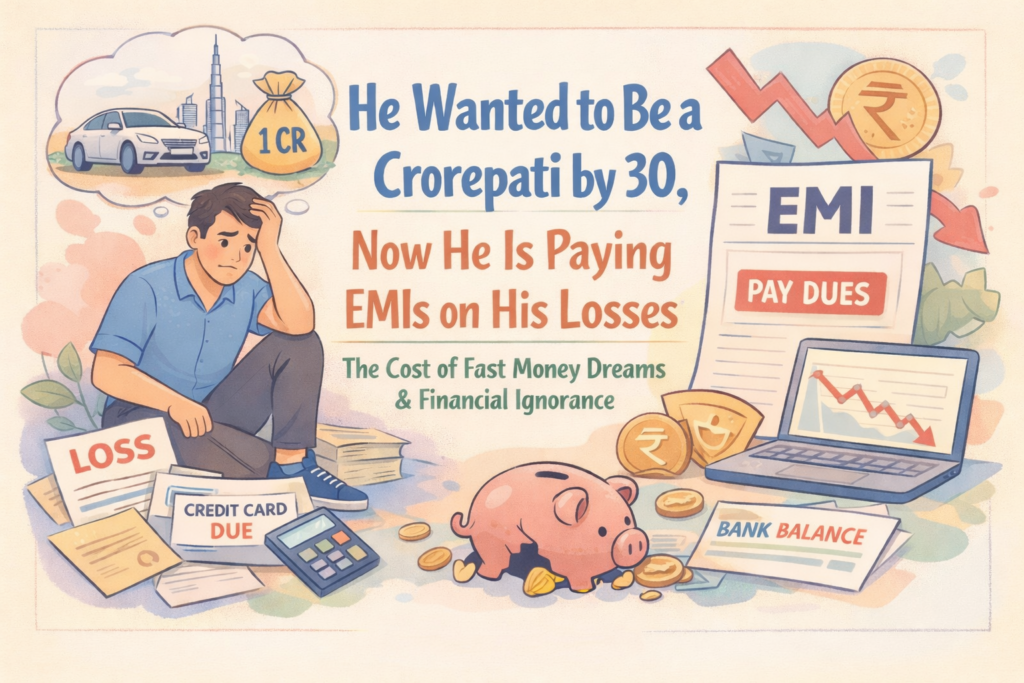
A story about ambition, shortcuts and the cost of financial ignorance
Rohit was 26.
Good salary.
Good job in Gurgaon.
Weekend outings.
EMI on a new car.
And a dream.
“I will become a crorepati before 30.”
He did not want slow growth.
He did not want boring SIPs.
He did not want 12 percent annual returns.
He wanted speed.
And the market gave him exactly what he wanted.
The Beginning of the Illusion
It started during a bull run.
Stocks were going up daily.
Every colleague had a “multibagger story.”
WhatsApp groups were full of screenshots.
Rohit opened a trading account.
First month profit ₹18,000.
Second month profit ₹42,000.
He felt intelligent.
He felt gifted.
He did not realise something important.
In a rising market, even average decisions look like genius moves.
The Shift from Investor to Trader
Soon SIPs felt boring.
Why invest ₹5,000 per month when options trading can give ₹20,000 in one day?
He stopped mutual funds.
He increased margin exposure.
He started F&O.
He began watching YouTube traders every night.
He joined two Telegram groups.
He bought a “secret strategy” course.
He learned entry points.
But he never learned:
-
Risk management
-
Position sizing
-
Stop loss discipline
-
Capital preservation
He knew how to buy.
He never learned how to survive.
The First Big Loss
One expiry day.
A confident trade.
Heavy position.
Market moved opposite.
Loss ₹75,000 in one day.
His hands were shaking.
But instead of stopping, he told himself:
“I will recover this tomorrow.”
This is where most retail investors fall.
Loss recovery trading.
Emotion over logic.
The Spiral
Next two months:
More leverage.
More revenge trades.
More “almost recovered” days.
Credit card used to fund trading.
Personal loan taken quietly.
Car EMI continued.
By 28, Rohit had:
₹6.5 lakh in losses
₹3 lakh personal loan
₹1.2 lakh credit card outstanding
He still had the dream of being a crorepati.
But now he was financing his losses with EMIs.
What Went Wrong
It was not the market.
It was not operators.
It was not manipulation.
It was ignorance mixed with overconfidence.
Rohit wanted wealth.
But he did not want education.
He wanted returns.
But he did not want discipline.
He wanted freedom from job.
But he never built financial foundation.
The Hard Realisation
One evening, he opened his bank statement.
Salary credit.
Loan EMI debit.
Credit card minimum due.
And almost zero savings.
That day he understood something powerful.
The market is not a shortcut.
It is a mirror.
It reflects your knowledge, discipline and psychology.
If you are impatient, it punishes you.
If you are greedy, it exposes you.
If you are unprepared, it charges you tuition fees.
And Rohit had paid expensive tuition.
What He Should Have Done
If Rohit had:
Started SIP at 25
Invested ₹10,000 per month
Earned 12 percent annual return
By 30 he would not be a crorepati.
But he would have:
Strong corpus
No debt
Growing confidence
Compounding on his side
Wealth is boring in the beginning.
But powerful in the long run.
The MoneyNivesh Academy Lesson
Everyone wants to become rich.
Very few want to become financially educated.
Before entering stock market, ask yourself:
Do I understand basic financial statements
Do I understand risk reward ratio
Do I know how much I can afford to lose
Do I have emergency fund
Do I have health and term insurance
If answer is no, market is not your enemy.
Your preparation is.
Final Thought
Stock market does not make people poor.
Lack of knowledge does.
Fast money dreams feel exciting.
Slow money building feels boring.
But one builds wealth.
The other builds EMIs.
Choose wisely.