
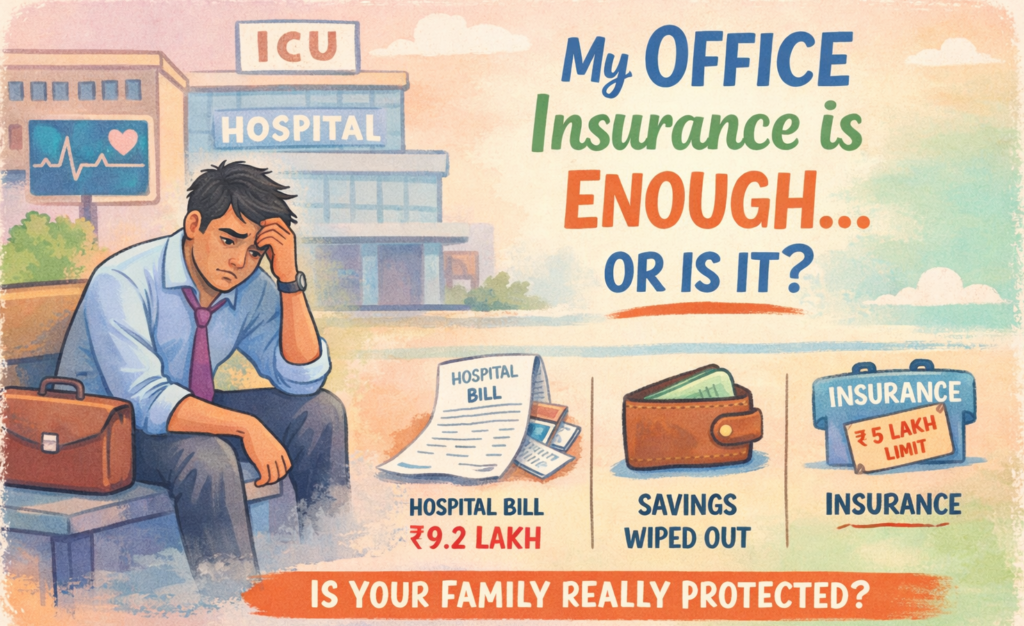
A real-life reminder that corporate health insurance is not complete protection
Amit was confident.
After all, he worked in a reputed IT company in NCR.
A decent salary.
A rented 2BHK in Noida.
And the comfort of knowing that his company provided ₹5 lakh corporate health insurance for his family.
“Why waste money on a separate health insurance policy?”
That’s what he told his friends back in Kolkata.
Like many corporate employees in India, Amit believed one thing:
Corporate health insurance is enough.
He was wrong.
The Comfortable Illusion
Amit moved from Bengal to NCR eight years ago.
Life slowly fell into place:
Monthly EMIs and rent
Weekend grocery runs
Occasional family trips
SIPs that he paused and resumed
And savings he felt proud of
His mother lived with them now, growing older, diabetic, yet medically stable.
No red flags.
No hospital visits.
No reason to worry.
Or so it seemed.
Then Came One Phone Call
One evening, his wife called him at work.
“Your mother fainted. We’re going to the nearest hospital.”
By the time Amit reached, the doctors had already shifted her to ICU.
Diagnosis:
Severe infection
Complications due to diabetes
Immediate monitoring required
The doctor spoke calmly.
“She’ll need ICU care for at least 5–6 days.”
Amit nodded, trying to stay composed.
Then came the line that changed everything:
“Estimated cost will be around ₹8–10 lakhs.”
“We Have Insurance”
Amit felt relieved.
He informed the hospital desk:
“We have corporate health insurance. Cashless.”
The executive smiled politely.
“Sir, your policy covers ₹5 lakhs.
ICU room rent has a sub-limit.
Some medicines and consumables are not covered.”
Amit didn’t understand half of it.
He just heard one thing:
You will have to pay the rest.
Five Years. One Bill. Zero Savings.
In the last five years:
ICU charges had doubled
Medicine costs had shot up
Diagnostic tests were no longer cheap
Even “basic” hospital rooms cost more than monthly rent
The final bill came to ₹9.2 lakhs.
Insurance paid:
₹4.7 lakhs (after deductions)
Amit paid:
His emergency fund
His fixed deposits
His wife’s gold savings
A personal loan
Years of disciplined saving…
Gone in one medical emergency.
The Question That Haunted Him
That night, sitting outside the ICU, Amit kept thinking:
“What if my company changes?”
“What if I lose my job?”
“What if this happens again?”
He remembered rejecting a ₹20,000 annual premium for a personal health insurance plan two years ago.
“Corporate insurance is enough,” he had said.
The Truth Corporate Employees Don’t Want to Face
Corporate health insurance is:
Employer-controlled
Limited in coverage
Full of sub-limits
Not designed for long hospitalizations
Taken away the day you resign or retire
And most importantly:
It has not kept pace with medical inflation.
Medical costs in India have increased 2–3x in the last 5–7 years.
Corporate policies haven’t.
MoneyNivesh Academy Takeaway
If you are a corporate employee in India, remember this:
Corporate health insurance is a benefit, not a backup plan
A personal health insurance policy is non-negotiable
Medical emergencies don’t ask:
Where you work
How much you earn
Or how confident you feel
They only ask one thing:
Are you financially prepared?
Amit learned this lesson the hard way.
You don’t have to.
Action Step (Do This Today)
Buy a separate family floater health insurance
Minimum cover: ₹10–15 lakhs
No room rent limit
Lifetime renewability
Buy it while you are healthy
Because one hospital bill should not be enough to erase years of hard work.
Calculate your ideal life insurance cover in under 2 minutes.