
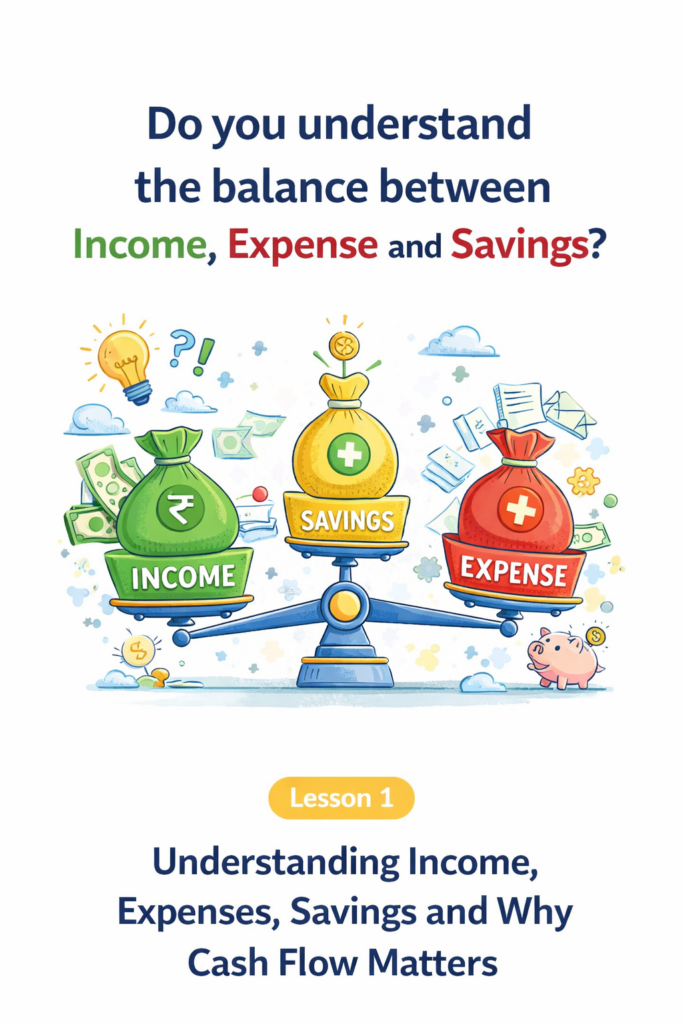
Most people believe wealth starts with investing.
In reality wealth starts with understanding your cash flow.
Cash flow simply means how money enters your life and how it leaves.
If you do not control this flow no investment strategy can save you.
What Is Income
Income is all the money you receive regularly.
For a salaried employee this may include salary bonus incentives and side income.
Example monthly income
Salary 60000
Freelance income 5000
Total income 65000
What Are Expenses
Expenses are the money you spend to live your life.
They usually fall into three categories
Essential expenses such as rent groceries electricity school fees
Lifestyle expenses such as eating out subscriptions shopping
Financial commitments such as EMIs insurance premiums SIPs
Example monthly expenses
Rent 15000
Groceries 8000
Utilities 3000
Transport 4000
EMI 10000
Eating out and shopping 6000
Insurance and SIP 5000
Total expenses 51000
What Is Savings
Savings is the money left after expenses.
Savings formula
Savings equals Income minus Expenses
Using the example
Income 65000
Expenses 51000
Savings 14000
This 14000 is your most important number because it represents your future.
Savings Ratio Calculation
Savings ratio shows how healthy your cash flow is.
Savings ratio formula
Savings divided by Income multiplied by 100
Using example
14000 divided by 65000 multiplied by 100
Savings ratio approximately 21 percent
General guideline
Below 10 percent financially vulnerable
10 to 20 percent average
20 to 35 percent strong
Above 35 percent aggressive wealth building
Why Cash Flow Matters More Than Income
A person earning 50000 saving 15000 is financially stronger than a person earning 1 lakh saving 5000.
Income creates opportunity
Cash flow creates wealth
Poor cash flow leads to
No emergency fund
Dependence on credit cards
Delayed investing
Financial stress
Strong cash flow leads to
Consistent investing
Financial confidence
Ability to handle emergencies
Faster goal achievement
Real Life Scenario
Two employees earn 70000.
Person A spends 65000 saves 5000
Person B spends 50000 saves 20000
After five years without any investment growth
Person A savings 3 lakh
Person B savings 12 lakh
The difference was not income.
It was cash flow behaviour.
Practical Exercise
Write down
Your monthly income
Your fixed expenses
Your lifestyle expenses
Your financial commitments
Calculate
Total expenses
Savings amount
Savings ratio
This is your starting point in financial planning.
Key Learning
Wealth building does not start with stock selection.
It starts with understanding where your money goes.
Control cash flow first.
Invest second.
Calculator Connection for Learning Hub
Use Financial Goal Planning Calculator after this lesson to see how increasing monthly savings changes your future corpus.
Even a small increase in savings can create a large difference because of compounding.