
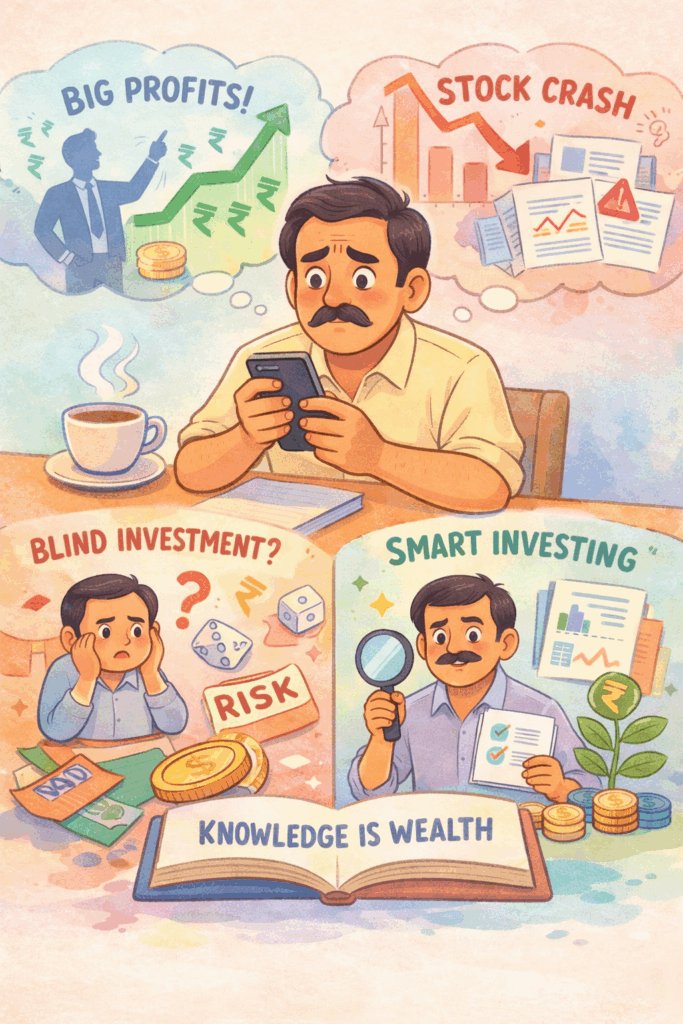
A simple investing story that explains why understanding fundamentals matters more than stock tips
Ramesh was not careless.
He was not greedy.
He was not even “new” to investing.
He had been saving for years.
FDs ✔️
LIC ✔️
PF ✔️
And then one evening, over chai and WhatsApp forwards, someone said:
“This stock will double in one year. Big people are buying.”
Ramesh opened his trading app.
Saw the stock had already gone up 40% in six months.
Felt the familiar fear — “What if I miss it?”
He clicked BUY.
No balance sheet.
No business understanding.
No idea why the stock should grow.
Just hope.
When Hope Replaces Knowledge, Markets Become Dangerous
For the first few days, the stock moved up.
Ramesh felt smart.
Then came results.
Revenue flat.
Debt rising.
Margins shrinking.
The stock fell 25% in a week.
Now Ramesh was confused.
“Should I average?”
“Should I exit?”
“Why is it falling when the company is good?”
But here’s the truth:
Ramesh didn’t know whether the company was good or bad.
He only knew the price, not the business.
And that’s where most investors fail.
Stock Market Is Not a Lottery. It’s a Business Marketplace.
When you buy a stock, you’re not buying a ticker symbol.
You are buying:
-
A business
-
Its management
-
Its future cash flows
-
Its risks
Imagine becoming a partner in a kirana store without knowing:
-
How much it earns
-
How much debt it has
-
Whether customers are increasing or decreasing
You wouldn’t do that in real life.
But people do it daily in the stock market.
Basic Analysis Is Not About Becoming an Expert
Let’s be clear.
You don’t need:
-
CFA certification
-
Complex financial models
-
Advanced valuation spreadsheets
You do need:
-
Basic understanding of financial statements
-
Clarity on how the company makes money
-
Awareness of risks
Basic analysis answers simple but powerful questions:
-
Is the company profitable?
-
Is revenue growing?
-
Is debt under control?
-
Is cash flow healthy?
-
Is the valuation reasonable?
If you can’t answer these, you are not investing.
You are speculating.
Why Long-Term Investors Still Lose Money
Many people say:
“I’m a long-term investor, I don’t need analysis.”
That’s dangerous advice.
Long-term investing doesn’t mean:
-
Buy anything
-
Hold forever
-
Ignore fundamentals
Long-term investing means:
-
Buying good businesses
-
At reasonable prices
-
With patience and discipline
Bad companies don’t become good just because you hold them longer.
Time magnifies quality — not mistakes.
Knowledge Gives You One Powerful Advantage: Calm
When markets fall, two types of investors exist.
Investor 1 (No Analysis)
-
Panics
-
Sells at loss
-
Blames market manipulation
-
Says “stock market is risky”
Investor 2 (Basic Analysis Done)
-
Understands business fundamentals
-
Knows whether problem is temporary or permanent
-
Uses volatility wisely
-
Stays calm
The difference is not intelligence.
It’s knowledge.
Stock Tips Are Loud. Financial Literacy Is Quiet.
Tips come daily:
-
Telegram groups
-
YouTube thumbnails
-
Office gossip
-
Social media influencers
Knowledge grows slowly:
-
Reading balance sheets
-
Understanding ratios
-
Learning business models
Tips excite you.
Knowledge protects you.
And protection is more important than returns
The Real Goal of Learning Stock Market Basics
It’s not about:
-
Beating the market every year
-
Becoming a trader
-
Predicting prices
It’s about:
-
Avoiding big mistakes
-
Understanding what you own
-
Building wealth with confidence
The stock market rewards patience, clarity, and preparation.
Not shortcuts.
Final Thought
If you are planning to invest in stocks, ask yourself:
“Do I understand what I’m buying, or am I just hoping it goes up?”
Hope is not a strategy.
Knowledge is.
At MoneyNivesh Academy, we believe:
Markets don’t cheat investors.
Unprepared investors cheat themselves.
What’s Next?
In upcoming blogs, I’ll break down:
-
Basic financial statements in simple language
-
Key ratios every investor must know
-
How to analyze a stock without complexity
If you want investing to feel calm, logical, and controlled, stay connected.
Because wealth is built with understanding, not excitement.