
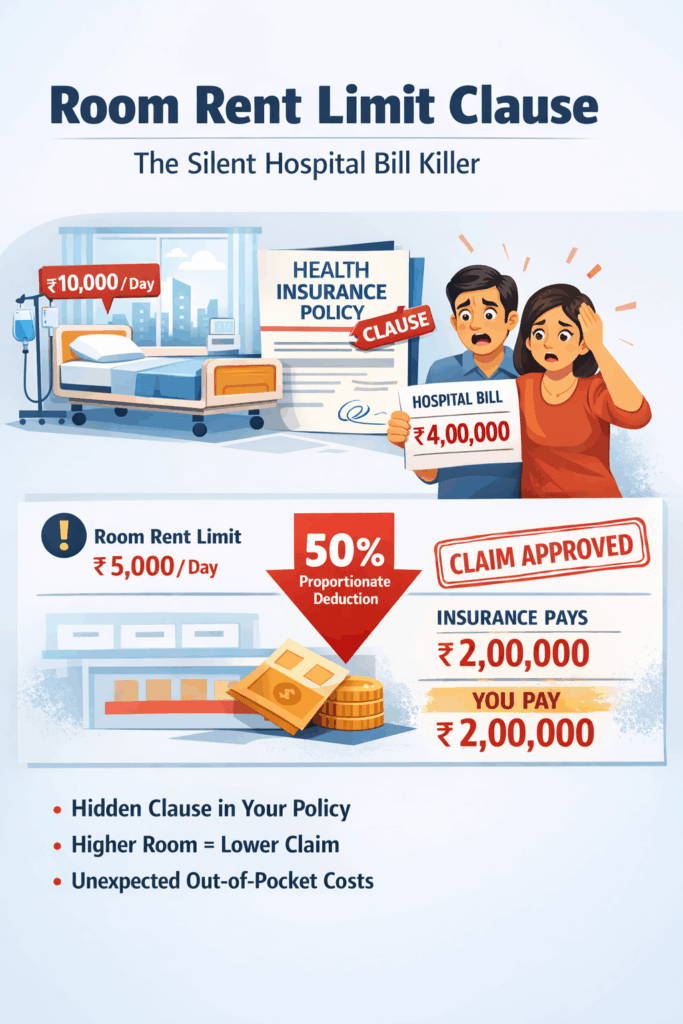
You buy health insurance thinking, “At least hospital bills are covered.”
But after hospitalization, you still pay ₹1–3 lakhs from your pocket.
No fraud.
No rejection.
Just one hidden clause quietly destroying your claim:
👉 Room Rent Limit Clause
Let’s decode why this clause is one of the biggest money traps in Indian health insurance.
🏥 What Is the Room Rent Limit Clause?
The Room Rent Limit is the maximum amount per day your insurance company will pay for your hospital room.
It’s usually defined as:
1% of Sum Insured per day, or
A fixed cap (₹3,000 / ₹5,000 / ₹10,000 per day)
If you choose a room that costs more than the allowed limit, the insurer doesn’t just reduce the room rent…
👉 They proportionately reduce the entire hospital bill.
That’s where the real damage happens.
💣 Why Is It Called a “Silent Hospital Bill Killer”?
Because:
Your claim is not rejected
The policy is active
The treatment is covered
Yet, you still lose a huge portion of your claim.
Most policyholders only discover this clause after discharge, when the final bill arrives.
📊 Real-Life Example (Very Common Case)
Policy Details
Sum Insured: ₹5,00,000
Room Rent Limit: 1% = ₹5,000 per day
Hospital Choice
Private room cost: ₹10,000 per day
Hospital stay: 5 days
Total Hospital Bill
Room charges: ₹50,000
Other charges (doctor, surgery, ICU, medicines): ₹3,50,000
Total bill: ₹4,00,000
❌ What Insurer Does
Room chosen is double the allowed limit.
So insurer applies proportionate deduction:
Allowed room rent = ₹5,000
Actual room rent = ₹10,000
Ratio = 50%
👉 Entire bill is reduced by 50%
Final payout by insurer: ₹2,00,000
Out-of-pocket expense for you: ₹2,00,000 😨
⚠️ Why Other Charges Also Get Cut?
Because many hospital costs are linked to room category:
Doctor consultation fees
Surgeon charges
Nursing charges
OT & procedure costs
Higher room = higher overall tariff.
Insurers argue:
“You voluntarily chose a higher-cost ecosystem.”
And legally, they’re right—if the clause exists in your policy.
🚩 Why Most Indians Fall Into This Trap
Agents focus on low premium, not clauses
Buyers ignore policy wordings
Hospitals upgrade rooms automatically during admission
Patients assume “room doesn’t matter much”
Employer policies hide limits in fine print
Result? Financial shock during medical emergencies.
✅ How to Protect Yourself (Very Important)
1️⃣ Buy Policies with “No Room Rent Limit”
This is the safest option.
Most good modern policies offer:
Any room (except suites)
No proportionate deduction
2️⃣ If Limit Exists, Choose Room Carefully
Always confirm:
Allowed room rent before admission
Ask hospital billing desk to stick to eligibility
3️⃣ Avoid %-Based Room Rent Limits
Prefer:
“Single private AC room allowed”
Instead of:“1% of sum insured”
4️⃣ Be Extra Careful with Corporate Insurance
Many employer policies still have:
₹3,000–₹5,000 room caps
Hidden proportionate clauses
Always ask HR for policy T&C.
🧠 Key Takeaway
Room rent is not just about comfort.
It decides how much your insurer will actually pay.
A cheap policy with room rent limits can cost you lakhs during hospitalization.
Before buying or renewing health insurance, ask one simple question:
👉 “Is there any room rent limit or proportionate deduction clause?”
If the answer isn’t crystal clear, walk away.
📌 Final Thought
Health insurance is meant to reduce stress, not add financial anxiety.
Understanding clauses like Room Rent Limit separates:
Smart buyers ❌ from regretful buyers
Protection ✅ from false security
Disclaimer: Policy terms may vary across insurers. Always read policy wording before purchase.